Why AI-Assisted Testing Needs an SOP Model
Overview
Most teams start using AI the same way: open a chat window, describe a problem, and hope for the best. That works for one-off questions — it fails for repeatable delivery work like testing, release validation, and triage, where consistency actually matters.
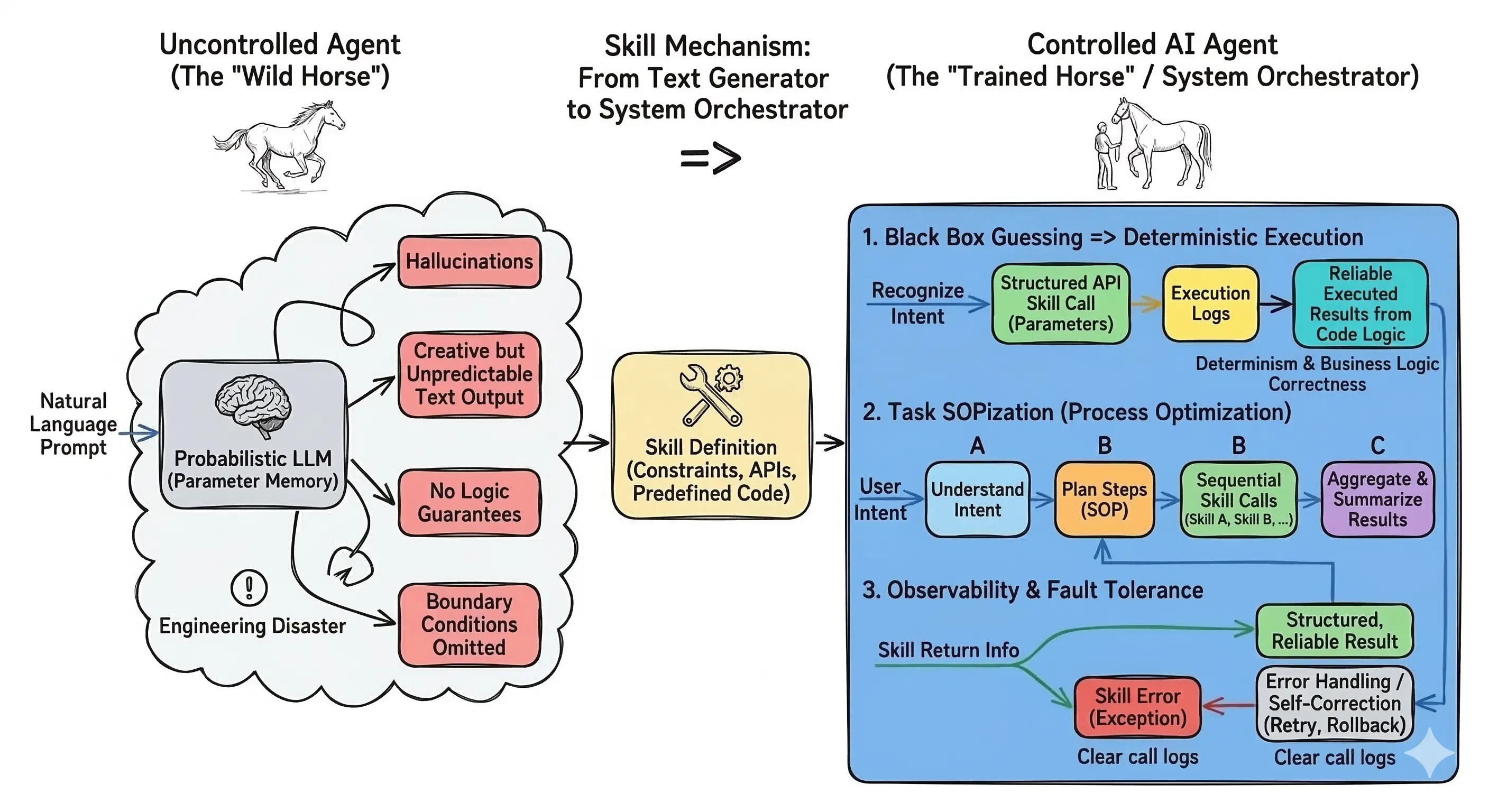
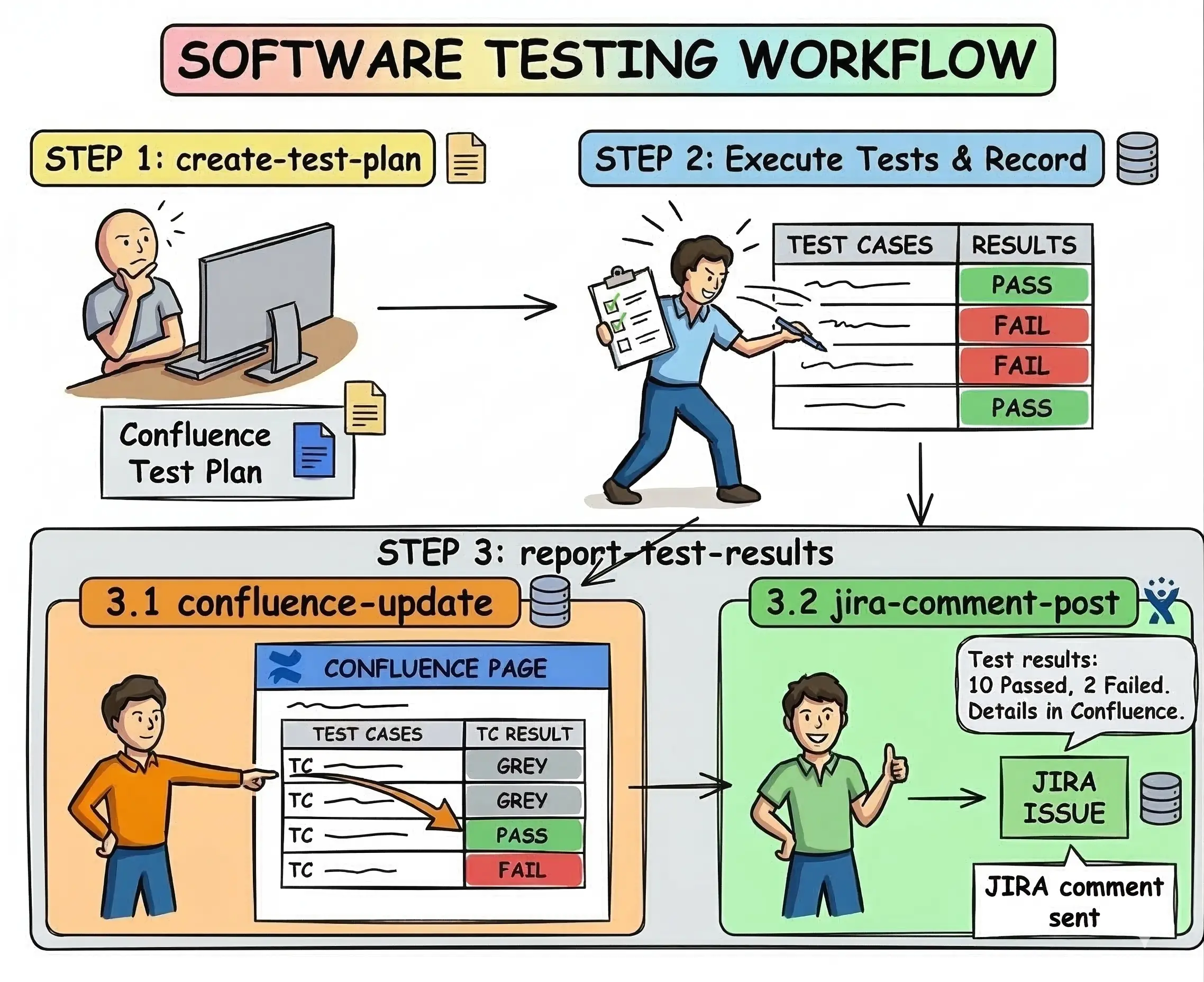
Figure: An SOP-style AI execution flow for software testing. Each stage has a defined input, a responsible skill, and a verifiable output.
Skills: The Unit of Repeatable AI Work
A skill is a self-contained instruction set that defines how a specific task should be completed — the right steps, the right tools, and the expected outputs. The outcome no longer depends on who wrote the prompt that day.
Key Components
| Component | Purpose |
|---|---|
| Reference | Loads only context relevant to the current step — keeps the active context window short, focused, and cost-efficient. |
| Script | Stores executable commands or static templates locally. The model needs only the declared commands and expected outputs — not full source code. |
How Skills Are Invoked
The Three-Layer Architecture
Reliable AI delivery is built from three distinct layers, each with a single, clear responsibility:
Custom Agent + Multiple Skills + Tool Connectivity (CLI / MCP)
| Layer | Responsibility | Analogy |
|---|---|---|
| Agent | Who the AI is — persona, safety constraints, tone, global behavior. Static and persistent. | Identity card |
| Skill | How work is done — task steps, API calls, templates, decision logic. Loaded on demand. | Professional license |
| Tool (CLI / MCP) | What the AI can reach — external services, databases, file systems. | Hands |
 Figure: Agent (left) owns identity and guardrails; Skill (right) owns task execution. The agent persists across sessions; skills are loaded per task.
Tool Connectivity: Default to CLI, Use MCP When It Earns Its Place
Two dominant patterns exist for agent-to-system interaction: CLI execution and MCP (Model Context Protocol) servers.
The Hidden Cost of MCP as a Default
Every MCP tool injects schema into the model's context — tool descriptions, parameter lists, capability declarations. Across a realistic integration set, MCP schemas can consume 30–40% of the usable context window before any real work begins.
Why CLI-First Wins
- Zero schema overhead — command help is read on demand; nothing sits in context permanently.
- Native composability — commands chain through pipes exactly as engineers already work.
- Testability — CLIs slot directly into CI pipelines and return structured output for deterministic assertions.
- No service layer — no server to deploy, monitor, or maintain for local and CI-scoped tasks.
When MCP Earns Its Place
The Team Decision Rule
 Figure: CLI execution (left) vs MCP integration (right). CLI is lean and direct; MCP adds a justified protocol layer only when centralized access control or cross-service standardization is required.
Summary
| Principle | What It Means in Practice |
|---|---|
| Skills are the unit of quality | Consistency comes from documented process, not better prompts |
| Layers have single responsibilities | Agent = identity · Skill = procedure · Tool = reach |
| Context is a finite resource | Prefer execution patterns that spend it on work, not overhead |
| CLI-first is the team default | Simpler, faster, more testable — escalate to MCP only when justified |